Esri.com
Design strategy for a B2B website
The Client
The Client
Esri
Esri
My Role
My Role
Research & Insights Creative Strategy Art Direction System Design CMS Migrations
Research & Insights Creative Strategy Art Direction System Design CMS Migrations
Project Team
Project Team
Amanda McKinley Carl Bender Paul Briseño
Amanda McKinley Carl Bender Paul Briseño


About this project
The Goal
Create a design strategy that would unify Esri.com across thousands of pages
Esri is the global leader in geospatial technology, and its website serves more than 2 million visitors annually. Between 2016 and 2018, the organization migrated thousands of pages to Adobe Experience Manager, significantly improving the site's technical foundation and user experience. What remained unresolved was the visual experience. With content being created across multiple teams, Esri.com needed a cohesive approach to storytelling, art direction, and design that could scale across the entire ecosystem.
The Problem
Every team was solving the same problem differently
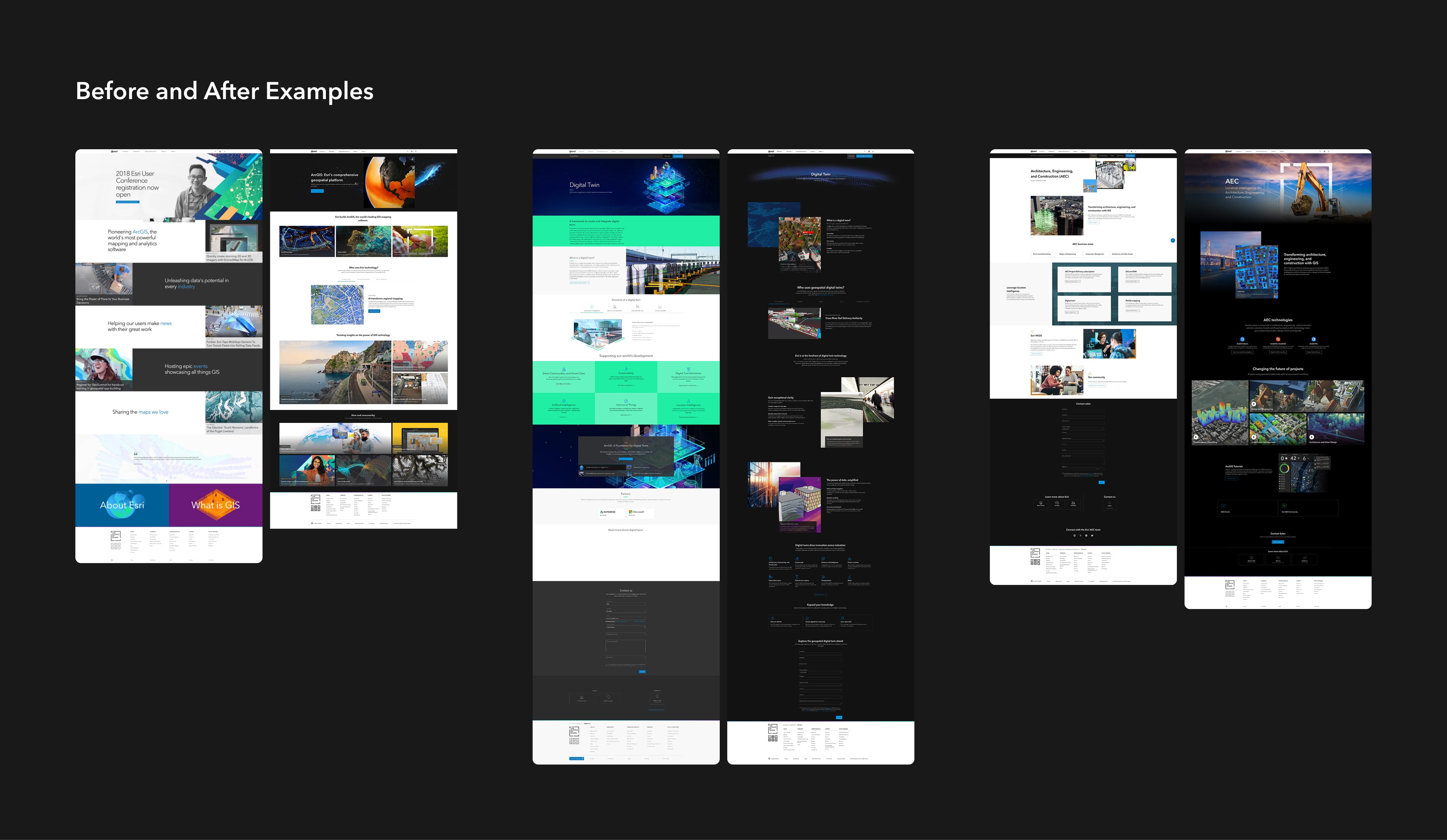
An audit of Esri.com revealed an experience that felt fragmented despite living on a single platform. Industry solutions, product marketing, technical documentation, and support content all reflected different approaches to visual communication. Through stakeholder interviews and workflow analysis, I found that the issue had nothing to do with a lack of communication or effort. Teams had simply developed their own methods over time, each optimizing for their own goals and constraints.
Without a shared design strategy, much of the site defaulted to industry conventions, like dense information, technical messaging, and inconsistent storytelling. The challenge was creating a visual system that made creative and strategic alignment across teams easy.
The Solution
Build a framework that scales with the organization
I approached the project as both a design challenge and an organizational one. Rather than prescribing rigid rules, I developed a flexible framework that helped teams make better decisions together. The strategy was built around three pillars: visual storytelling templates that elevated communication and engagement, collaborative workflows that improved alignment across cross-functional teams, and adaptable guidelines that balanced consistency with autonomy. By focusing on people and process alongside design, we created a system that could evolve with the organization while maintaining a more cohesive and recognizable experience across thousands of pages.
The Impact
The framework now governs hundreds of thousands of pages.
The new strategy was rolled out right before two additional CMS migrations and made those multi-year projects much easier to navigate. Design/stakeholder friction was reduced, go-to-market timelines improved, and trust in the design team grew across the organization. And the new designs are performing well:
45%
increase in core product page views
$100K+
saved for reducing technical support cases created
11%
improvement in positive impression ratings
About this project
